
Corporate Governance

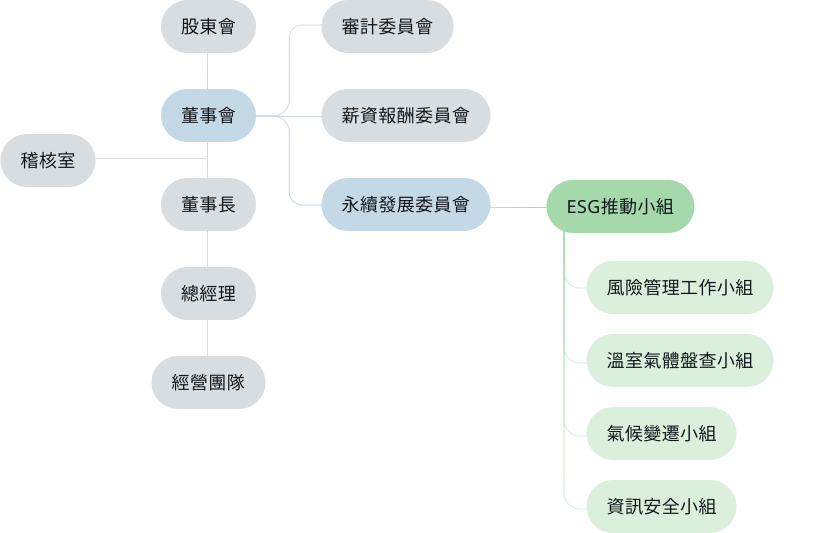
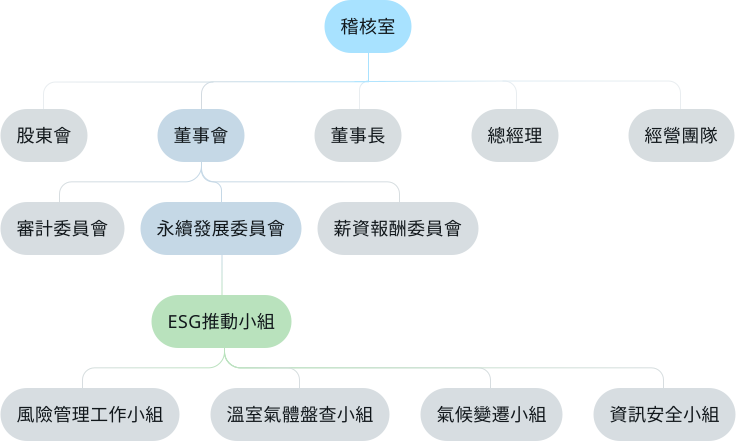
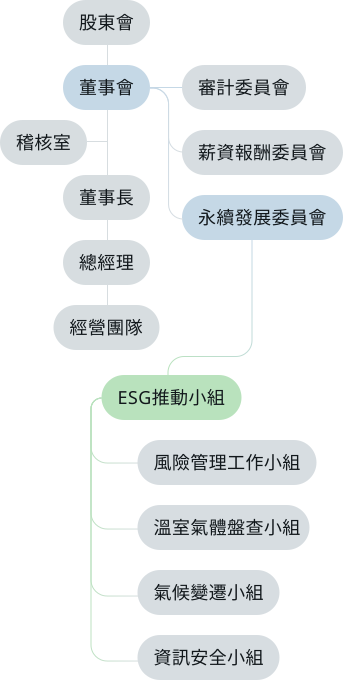
Corporate Governance Structure
board of directors
Functional committees
Human Rights Policy
Risk Management
Ares Security Risk Management
Intelligent Property Management
Head of Corporate Governance
Internal Audit
Rules and Regulations
Supplementary Information

Corporate Governance Structure

The Company recognizes that a sound and effective Board of Directors is the foundation of sustainable management. The Company complies with the legal and regulatory bases, and the Board of Directors has
The Board of Directors consists of seven members, including three independent directors. All directors are elected by shareholders' votes without any gender difference or limitation.
The main duties of the directors are to supervise and guide the execution of the Company's business and the resolution of major decisions in order to maintain a high standard of corporate governance and further ensure the development of the Company.
The main duties of the directors are to supervise and direct the Company's business execution and decisions on major decisions in order to maintain a high standard of corporate governance, which in turn ensures the Company's development and protects shareholders' interests.

Board Diversity and Independence

I. Diversity of directors

The Company's Board of Directors has adopted Chapter 3 of the "Code of Corporate Governance Practices", which sets forth guidelines for enhancing the diversity of the Board's functions, including
but not limited to the following two major criteria:

  • Basic requirements and values: gender, age, nationality, culture, etc.
  • Professional Knowledge and Skills: Professional background, professional skills and industrial experience, etc.

ii. independence of directors

  • The Board of Directors complies with the "Regulations Governing the Election of Directors and Supervisors" and the "Code of Corporate Governance Practices", and the nomination and selection of its members are in accordance with the Company's Articles of Incorporation.
    In accordance with the Company's Articles of Incorporation, the nomination and selection of members of the Board of Directors is based on the candidate nomination system, and shareholders are encouraged to participate. Shareholders holding a certain number of shares or more may propose a list of candidates.
    The acceptance process is conducted and announced in accordance with the law to protect shareholders' rights and interests, to avoid monopolization or excessive abuse of the nomination right, and to ensure the independence of the board of directors.
    The independence of the board of directors is ensured.
  • The Company has established a board of directors' performance evaluation system. In accordance with the board of directors' approved board of directors' performance evaluation method, the Company conducts a board of directors' internal self-evaluation and board members' self-assessment once a year.
    In accordance with the Board's approved board performance evaluation method, the Company conducts an annual internal self-evaluation of the Board of Directors and a self-evaluation of the Board members, and the results are disclosed in the Company's annual report and in the Corporate Governance section of the Company's official website.

Remuneration Committee

The Compensation Committee of the Company shall evaluate the Company's policies and systems for directors' and managers' remuneration on a professional and objective basis and make recommendations to the Board of Directors. The Committee shall consist of independent directors of the Company appointed by resolution of the Board of Directors, with the total number of members not less than three, and shall elect one of the independent directors to be the convenor and chairman of the meeting.
Its duties shall be:

1. To establish and regularly review the policies, systems, standards and structures for performance evaluation and compensation of directors and managers.
2. Evaluate and determine the remuneration of directors and managers on a regular basis.
3. The professional qualifications, independence, and exercise of authority of the committee members shall be in accordance with the Company's "Rules and Regulations Governing the Compensation Committee".
4. Other cases to be referred by the Board of Directors.

Audit Committee

The Audit Committee of the Company consists of all independent directors, and in accordance with the regulations, its number shall not be less than three, at least one of whom shall have accounting or financial expertise, and all members shall elect one from among themselves to be the convenor and chairman of the meeting. The operation of the Audit Committee is mainly for the purpose of supervising the following matters:

1. To audit the appropriateness of the Company's financial statements.
2. To certify the selection (dismissal), independence and performance of the accountants.
3. Establish or amend the internal control system and implement it effectively.
4. Supervise the Company's internal compliance with relevant laws and regulations.
5. Control and management of the Company's existing or potential risks.

Sustainable Development Committee

The Board of Directors of the Company has established the "Sustainable Development Committee", which is the highest decision-making and supervisory unit for corporate sustainable management, supervising the Company's practice of sustainable development, reviewing the effectiveness of its implementation at any time and making continuous improvements to ensure the promotion of sustainable development policies, the fulfillment of corporate social responsibility, and the attainment of the concept of sustainable management.

The number of members of the Committee shall not be less than three, who shall be appointed by resolution of the Board of Directors, half (inclusive) of whom shall be independent directors, and one member shall be elected by all members to act as the chief convenor and chairman of the meeting.

The Committee shall be accountable to the Board of Directors, and shall perform its duties faithfully as a good steward in accordance with the principle of sustainable corporate management, and shall submit the proposed resolutions to the Board of Directors for resolution.

The main objectives of the Committee are to
1. To implement corporate governance.
2. To develop a sustainable environment.
3. Maintain social welfare.
4. Enhance the disclosure of corporate sustainability information.

Scope of responsibilities of the Committee:
1. Promote corporate sustainability and emphasize management in the three major areas of corporate governance, the environment, and society.
2.To implement the corporate governance system and strictly abide by the principle of integrity management.
3. Execute and supervise risk management related matters.
4. Execute other related matters resolved by the Board of Directors.

Human Rights Policy

The Company abides by the labor-related laws and regulations in the locations of its global operations and follows the spirit and basic principles of human rights protection enshrined in various international human rights treaties, including the International Labor Convention and the United Nations Universal Declaration of Human Rights, to safeguard the legitimate rights and interests of its employees, to fully embody its responsibility to respect and protect human rights, and to treat all of the Company's associates with dignity and respect.

The main elements of the human rights policy are as follows:

  • Protection of human rights in the workplace
  • Implementation of equal pay for equal work
  • Providing a healthy and safe workplace
  • Promoting Labor Harmony
  • Personal Data Protection

Risk Management

The Company formulated the "Risk Management Policy" in 2010 as the highest guiding principle for risk management of the Company. Risk factors are identified annually to identify the relevant risks that may affect the sustainable development of the Company, and the risk management areas are screened out, and in accordance with the latest development of internal auditing and the requirements of the standards, the potential risks are monitored and preventive measures are implemented to strengthen the risk management, and the risk management objectives, organizational structure, attribution of authority and responsibility, and the mechanisms of risk management procedures are set and implemented to control the risks within acceptable limits. We will formulate risk management objectives, organizational structure, authority and responsibility, risk management procedures and other mechanisms and implement them in order to control all risks within an acceptable range.

Risk Management Scope
The Company will define the unit of responsibility for each risk factor by identifying the potential risks that may affect the Company's operations and profits, such as strategic, operational, financial, information security and hazardous risks. Each unit of responsibility will evaluate the frequency of occurrence of risk events and the severity of the impact on the Company's operations through the risk identification process, using the risk matrix to define the priority of risks and the level of risks, so as to clearly understand the scope of each risk and adopt corresponding risk management strategies according to the level of risks to ensure the proper management of relevant risks. The Company adopts corresponding risk management strategies based on the risk level and takes appropriate measures to ensure proper management of the related risks. Risks identified by the Company include business risks, operational risks, financial risks, legal compliance risks, information security risks, and hazardous event risks. The President is the highest authority for risk management, and each responsible unit is responsible for identifying and controlling each risk in accordance with the organizational structure.

Ares Security Risk Management

In order to ensure the security and stability of the Company's network and information usage environment, the Information Department of the Company is responsible for implementing and enforcing the information security operations in accordance with the "Guidelines on Information Security Control for Listed and OTC Companies" issued by the competent authorities, which include the core business and its significance, information security system inventory and risk assessment, information security system development and maintenance, information security protection and control measures, management measures for outsourcing the information security system or information security services, notification and response to information security incidents and assessment of the situation. management measures for outsourcing of information and communications systems or services, information and communications security incident notification and response, and assessment and response to information and communications security incidents.

The main policies are set out below:

  1. Core business and its importance.
  2. Inventory and risk assessment of the Ares system.
  3. ACTS develops and maintains security.
  4. ACTC Safety Protection and Control Measures.
  5. The Ares system or Ares service is outsourced.
  6. Response to security incident notification and assessment.

Intelligent Property Management

The Company has long been committed to the research and development of advanced technologies and has accumulated a lot of valuable knowledge and experience. In order to protect the results of the research and development, to enhance the competitive advantage of the products and to reduce the operational risks, and to implement the compliance with the laws and regulations of the intellectual property rights, the Company has established the Intellectual Property Management System, which serves as a guideline for the decision-making and implementation of the relevant affairs of the units in dealing with the intellectual property and other related matters.

Meanwhile, in order to protect the value of the Company's brand, the Company has applied for trademark registration of the Company's brand and main product series logos according to their marketing areas, so that the Company's brand can be well protected. The Company has formulated the "Intellectual Property Management Plan", which was approved at the sixth board of directors' meeting held on November 9, 110th. The management plan covers various intellectual properties, such as patents, trademarks, copyrights, and trade secrets, issued or obtained by our employees and outsiders participating in our research programs.

Head of Corporate Governance

In order to implement corporate governance and to enable the Board of Directors to perform its functions effectively, the Company, by a resolution of the Board of Directors on November 9, 110, appointed Manager Wenwen Gao as the Head of Corporate Governance, who is responsible for matters related to corporate governance.

The key responsibilities of the Head of Corporate Governance are set out below:

  1. To handle matters related to the meetings of the Board of Directors, the Functional Committee and the Shareholders' Meeting in accordance with the law.
  2. Preparation of minutes of board and shareholder meetings.
  3. To assist the Directors in their appointment and continuing education.
  4. To provide information necessary for the directors to carry out their business.
  5. To assist directors and managers in complying with the Act.
  6. To assist in the enforcement of other laws and regulations, contracts, or matters provided for in the Company's Articles of Incorporation.
  7. Regularly report to the Board of Directors on the operation of corporate governance on an annual basis.

Internal Audit

Internal Audit Organization

  • The Company's Audit Office is under the Board of Directors and is staffed by a full-time internal auditor and an audit agent.

Internal Audit Operations

    1. The purpose of the internal audit is to assist the Board of Directors and managers in checking and evaluating the deficiencies of the internal control system and measuring the effectiveness and efficiency of the operations, and to provide timely recommendations for improvement to ensure the continuous and effective implementation of the internal control system and to serve as a basis for reviewing and revising the internal control system.
    2. Internal audits are conducted in accordance with the "Guidelines Governing the Establishment of Internal Control Systems by Public Companies" and the annual audit plan is prepared and executed on a monthly basis, and project audits are conducted as necessary to identify possible deficiencies in the internal control system and make recommendations for improvement in a timely manner.
    3. The internal auditors are independent in spirit and perform all internal audits of the Company.
    4. The Head of Audit reports regularly to the Audit Committee on the audit engagements and attends the Board of Directors' reports.
    5. If the internal auditor discovers a material breach of regulations or a risk of material damage to the Company, he or she shall immediately prepare an audit report and submit it to the Audit Committee, which shall immediately send it to the Board of Directors upon receipt of the report.

Internal Audit Procedures

  1. Routine Internal Audit
    Based on the results of risk assessment, an audit plan for the following year is scheduled and submitted to the Audit Committee and the Board of Directors, and the scope of audit items covers important control operations.
  2. Ad Hoc Audit
    The main purpose is to supplement the above routine audits to monitor exceptional events and respond to risks, and the subject of the audit is designated by the competent authority, the board of directors, or the management.
  3. Self-audit Supervision and Evaluation
    Each department's internal control system self-inspection results are reviewed and analyzed, and the "Internal Audit Self-Assessment Report" is compiled and submitted to management.
  4. The internal audit performs various audits and prepares an "Audit Report" to be submitted to the Audit Committee and the Board of Directors. For internal control deficiencies and anomalies identified in the Audit Report, the auditors will follow up on the implementation of the improvement items on a regular or irregular basis, and prepare a "Statement of Internal Control System" to be submitted to the Audit Committee and the Board of Directors.
  5. Internal audit report:
    By the end of December each year: Audit plan for the following year.
    By the end of January of each year: List of internal auditors.
    By the end of February each year: the actual implementation status of the previous year's audit plan.
    By the end of March each year: Statement of internal control system.
    By the end of May each year: Internal control system deficiencies and irregularities observed in the previous year's internal audit.

Appointment and Removal of Internal Auditors

The appointment, removal, evaluation, and compensation of the Company's internal auditors are approved by the Chairman of the Board of Directors, except for the appointment and removal of the audit supervisor, which is approved by the Audit Committee and submitted to the Board of Directors for resolution as stipulated by the Act, and the related regulations are disclosed in the Company's internal rules and regulations section.